Palestine Action judge pulled as fears of bias grow
Accusations after judge replaced by one with family links to arms industry

The judiciary is refusing to explain its last-minute decision to remove the judge assigned to Huda Ammori’s legal case. This pertains to the government’s hotly-contested designation of Palestine Action (PA) as a terrorist group.
Is this a stitch-up?
The removal of judge Michael Chamberlain has led to accusations of a “stitch-up”. The government is artfully sidestepping a judicial review which could overturn the Israel-driven proscription of a non-violent anti-genocide protest group.
The government’s position is already weakened. The occurred after the lies told by then-Home Secretary Yvette Cooper — to justify the ban — were exposed.
The legal challenge to Starmer’s ban begins today. The Ministry of Justice (MOJ) declined to answer media enquiries about the switch. Instead they referred journalists to the judiciary press office, which also refused to comment.
The judiciary also removed Chamberlain at the last minute from presiding over a legal challenge to the UK’s sale of F-35 warplane parts to Israel.
He granted permission for both judicial reviews. However, he refused to set aside the PA case, while it remained under deliberation. This was to protect anti-genocide protesters from wrongful arrest and prosecution. He also rejected the Home Office’s attempt to have Ammori’s case summarily thrown out.
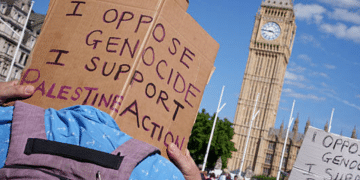
In response to his unjust recusal, Defend Our Juries (DOJ) — a group which has organised mass protests against the PA ban, said transparency is essential and determines the future of 2,350 protesters — vilified and criminalised for bearing lethal cardboard signs:
The public deserves transparency, not backroom manoeuvres to cherry-pick judges, threatening the fundamental principle of judicial independence.
Judicial independence under threat
Campaign Against Arms Trade (CAAT) spokesperson Emily Apple pointed out that the judge who will replace Chamberlain has:
family links to banks and other institutions targeted by Palestine Action because of their connections to the arms trade and their complicity in Israel’s genocide in Gaza [and this] raises serious questions around the lack of impartiality and transparency in our judicial system, and whether this is now a pattern in significant legal cases concerning Palestine.
A DOJ spokesperson added:
The last-minute removal of Justice Chamberlain – a judge widely respected for his fairness and independence – without any explanation makes it hard not to draw the conclusion that this is a stitch-up. Justice Chamberlain had been consistently confirmed as the judge presiding over this judicial review — in court documents, correspondence, and in related criminal hearings involving peaceful protesters arrested for holding signs.
If [High Court King’s Bench president] Dame Sharp believed a panel of judges was necessary, the usual process would have been to add judges to sit alongside him, not to remove Chamberlain entirely – especially as he is one of the most senior judges on the High Court bench so this cannot be explained on grounds of seniority.
The judiciary is meant to be independent of political influence. Yet with no transparency around this decision, and with the removal of the same judge in another major legal case concerning Palestine, public confidence is being seriously undermined. That two of the replacement judges have alleged links which could raise the appearance of a conflict of interest only deepens these concerns. This includes Dame Sharp’s family connections to Boris Johnson, to prominent pro-Israel lobbyist and major Labour Party donor Trevor Chinn, and the group Quilliam, which has been widely discredited as Islamophobic and for supporting Tommy Robinson.
Meanwhile, Justice Swift said his favourite clients were the security and intelligence agencies and many times represented the Home Office, which is the defendant in this judicial review.
In a case of such national significance – determining whether over 2,350 peaceful protesters will continue to be criminalised as ‘terrorists’ for holding cardboard signs – the public deserves transparency, not backroom manoeuvres to cherry-pick judges, threatening the fundamental principle of judicial independence.
A test of our civil liberties
CAAT’s Emily Apple said:
Justice Chamberlain’s last minute removal is deeply alarming. It is even more concerning that his replacement has family links to banks and other institutions targeted by Palestine Action because of their connections to the arms trade and their complicity in Israel’s genocide in Gaza.
This raises serious questions around the lack of impartiality and transparency in our judicial system, and whether this is now a pattern in significant legal cases concerning Palestine. The court must now explain what’s happened to ensure public trust in a judicial review that is a crucial test of our civil liberties, and our right to challenge the companies breaking international law to profit from Israel’s war crimes.
The judicial review at the High Courts begins at 10:30am and is expected to last three days.
A further protest against the ban is taking place – including Holocaust survivors and their descendants — and more ‘terror’ arrests are likely as the Starmer regime continues to try to protect Israel from scrutiny and accountability.
Featured image via Martin Pope/Getty Images