The corporations making up the Taskforce on Nature-related Financial Disclosure hold a prolific record of ecological and human rights violations

Corporations wrecking the planet and harming frontline communities have added a new chapter to their greenwashing playbook. On 18 September, a prominent business-led initiative published the final draft of a new set of corporate disclosure guidelines.
As part one of this two-part series detailed, rights groups and environmental non-profits have been raising the alarm on the corporate capture of the of the Taskforce on Nature-related Financial Disclosure (TNFD) from its inception.
Now, the Canary has identified that communities, non-profits, and media outlets have made close to 300 rights allegations in just 10 years against the companies running the taskforce. What’s more, financiers involved in the initiative have ploughed hundreds of billions of dollars into climate-wrecking and ecocidal companies.
Prolific rights violators in the TNFD
The non-profit Business and Human Rights Resource Centre (BHRRC) hosts a ‘company response mechanism’. This draws together allegations of human rights violations from community accounts, non-profit publications, and global media reports.
Specifically, where records of abuse exist and companies have not publicly made a statement, the BHRRC offers the corporation the opportunity to respond. While some violations might pertain to the same project, the database treats each response request as a separate instance of allegations against a company, because they derive from different sources.
The Canary found that the corporations comprising the TNFD collectively held at least 288 separate response requests in the ten years from 2013 to present. We included subsidiary businesses in the count.
Notably, five companies in the TNFD were responsible for over 50% of these allegations. Mining giant Anglo American, food conglomerate Nestle, MS&AD Insurance Group, fossil fuel firm Ecopetrol, and agrichemical multinational Bayer topped the list.
Anglo American, for instance, appears in the database regularly for its former shareholdings in the controversial Cerrejón coal mine in Colombia. The open-pit mine has displaced Wayúu Indigenous and Afro-descendant communities from their ancestral territories. Moreover, its operations have endangered the health of nearby inhabitants.
Meanwhile, Nestlé’s prolific rights-violation record spans its food commodity operations across the globe. The company has multiple reports of rights violations in its palm oil supply chain across Brazil, Guatemala, Indonesia, and Colombia. Similarly, campaign groups have linked its coffee and chocolate product supply chain to forced labour, and harmful impacts on Indigenous communities in multiple countries.
Pouring finances into ecocide
Overall, the BHRRC database held fewer allegations against financial institutions compared to companies from more extractive industries. Instead, these financiers have funnelled huge sums to these corporations engaging in ecocide.
Collectively, TNFD banks have invested US $33.8bn into big agribusiness companies. Notably, these companies often harvest commodities with high risks of deforestation.
The Dutch Rabobank topped the list of forest-risk financiers. It accounted for nearly a third of the total investments by TNFD members. In particular, the bank has poured hefty sums in the form of loans and credit into agri-giants like Cargill, Bunge, Olam International, and Louis Dreyfus.
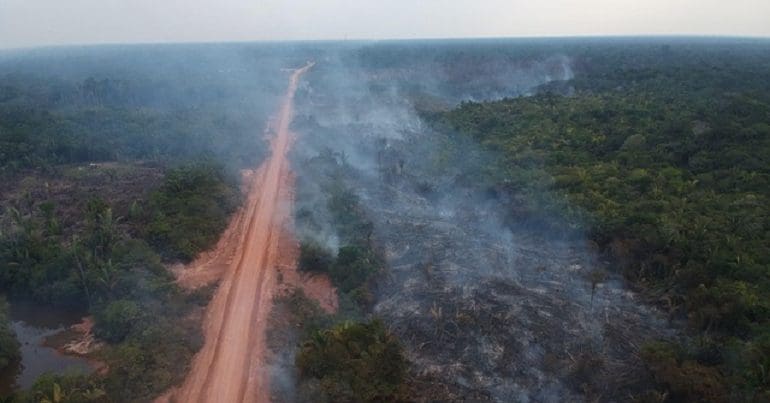
In particular, Greenpeace Netherlands and independent research group Profundo exposed Rabobank’s role in funding deforestation in Brazil. Between 2000 and 2022, Rabobank channelled nearly US $10bn to high-risk deforestation products including soy, beef, pulp, and paper.
What’s more, a number of the TNFD banks have also appeared in the Banking on Climate Chaos report. The annual publication by a group of non-profits documents the 60 worst banks for financing fossil fuel companies. The TNFD financiers in the report included the Bank of America, BNP Paribas, HSBC, Rabobank, and UBS. Together, they have funded ecocidal oil and gas corporations to the tune of nearly US $650bn.
‘Empowering global corporations’
Shona Hawkes, a senior advisor at the Rainforest Action Network, expressed her disappointment at the shortcomings in the TNFD’s final publication:
At heart, the process has focused on empowering global corporations – including members of its corporate taskforce who are failing to act on their own environmental or human rights harms. Nothing in the TNFD framework challenges a corporation’s right to keep 100% of the profits it may make off environmental or human rights abuses. Nor does it uphold nature’s own right to exist. It is full of loopholes that can allow for rampant greenwashing and its reporting takes a generalized form that means that company claims cannot be checked against realities on the ground.
As Hawkes pinpointed, the voluntary guidelines fall short of holding corporations to account for their environmental and human rights harms.
Evidently, the corporations leading the TNFD initiative have every reason to attempt to evade scrutiny. Given the scale of the TNFD taskforce members’ rights violations alone, it’s clear that the new framework is severely unlikely to protect communities and nature – but it might just save the corporate bottom-line.
Featured image via Wikimedia Commons/Tanenhaus, resized to 1910*1000, licensed under the Creative Commons Attribution 2.0 Generic license.