Across Europe counterterrorism laws are being weaponised to protect Israel and silence dissent

According to a new report from the European Legal Support Centre (ELSC), governments across Europe are turning solidarity into a threat. What began as counterterrorism legislation has evolved into continent-wide repression targeting anyone who stands with Palestine. The report reveals how states deploy vague and racialised counterterror laws to silence dissent and protect their complicity in Israeli violence. These laws, the report argues, have created a regime of political vetting in which democratic rights are conditional and empathy is treated as extremism.
Governments are framing solidarity with Palestine as a threat to security via counterterrorism
From Britain to France, Germany to the Netherlands, the pattern is unmistakable. Authorities now describe solidarity as a security problem, criminalising political speech, community organising, and humanitarian advocacy. Governments use the language of extremism and national security to suppress movements exposing their collaboration with Israel’s ongoing assault on Palestinians. The ELSC situates this crackdown within the wider context of Israeli violence, documenting mass displacement, starvation, and the systematic destruction of infrastructure in Gaza. Yet rather than curb arms sales or impose sanctions, European states have expanded policing powers at home to protect Israeli impunity abroad.
During the age of empire, European powers relied on emergency laws to suppress anti-colonial movements. Today, the report says, those same legal tools are redeployed under counterterrorism, turning protest into a threat to the state. What was once colonial repression overseas has become domestic policy.
State authorities, Zionist lobby groups, and arms manufacturers work closely together to suppress Palestinian rights activism. This alliance fuels repression not only locally, but also throughout Europe.
ELSC: proscription of Palestine Action protected UK government’s economic interests in the Israeli occupation’s arms industry
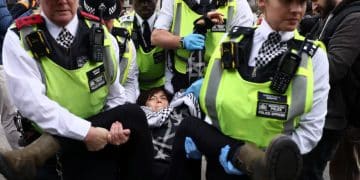
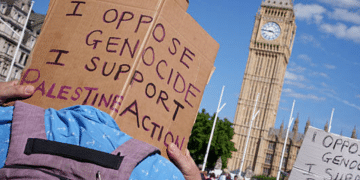
Britain has become a key laboratory for this strategy. In July 2025, the UK government banned the direct-action group Palestine Action under the Terrorism Act 2000. The organisation had led an extremely successful nationwide campaign targeting Elbit Systems, Israel’s largest weapons producer, which profits from arms used in Gaza. More than 800 activists were arrested in the aftermath. Officials justified the ban by claiming the group’s actions caused serious property damage, but the ELSC’s analysis revealed only a fraction of its actions could possibly meet the legal definition of terrorism.
The ban protected Elbit’s operations and aligned with British economic interests tied to the Israeli arms industry. The Home Office pushed through the proscription by grouping Palestine Action with neo-Nazi organisations, ensuring parliamentary approval without debate. Courts upheld the ban despite the lack of evidence, revealing that the decision was political rather than legal.
Prevent Strategy leads to silencing of Palestine solidarity
At the same time, there is the UK government’s Prevent Strategy, which aims to identify people at risk of committing terrorist acts. It continues to extend surveillance into every corner of public life. The government instructs teachers, doctors, and social workers to report signs of “radicalisation”. These now include activism or even expressions of empathy for Palestinians. The ELSC warns that this produces a climate of fear and self-censorship. In effect, Britain has transformed care workers and educators into agents of the security state, where acts of compassion risk investigation. According to the ELSC , the country has turned empathy into evidence.
In Germany, repression operates through bureaucracy. The Interior Ministry can dissolve groups without trial, using the Associations Act, if they are deemed to threaten public order. It has used this power to outlaw entire movements that advocate for Palestinian liberation. In November 2023, Interior Minister Nancy Faeser banned the Samidoun Palestinian Prisoner Solidarity Network after Israeli officials demanded restrictions. Police raided homes, confiscated materials, and declared that the slogan “From the river to the sea” promoted terrorism. The ELSC found that Germany’s intelligence services then used the ban to revoke a Palestinian refugee’s status, citing Samidoun’s listing by Israeli authorities despite the absence of domestic legal justification.
In May 2024, Germany also banned the small grassroots group Palästina Solidarität Duisburg, based on a 240-page dossier filled with misrepresentations and factual errors. Police raids followed, with reports of harassment, threats, and property seizures. Members lost jobs and residence permits, their speech monitored and their activism categorised as extremism. The ELSC shows how these cases establish a dangerous precedent, allowing intelligence agencies to label any pro-Palestine organisation as a security risk while supplying the data used to justify future repression.
Criticism of Israel’s genocidal regime equated with hate speech
France has pushed this system even further. President Emmanuel Macron’s government routinely dissolves organisations by administrative decree using its Internal Security Code, eliminating the need for judicial oversight. Since 2022, French authorities have banned several Palestine solidarity collectives in this way, including Collectif Palestine Vaincra, Comité Action Palestine, and Urgence Palestine. Officials invoke legal phrases such as “apologie du terrorisme” to justify the dissolutions, collapsing criticism of the Israeli regime into hate speech. In the case of Urgence Palestine, the Interior Ministry froze assets and raided homes before even issuing an official decree.
Under Macron, dissolutions have become a permanent tool of rule, extending far beyond Palestine activism to include Muslim charities and anti-fascist groups. Once dissolved, individuals face continuous surveillance, restricted movement, and possible imprisonment for “reconstituting” a banned organisation. The ELSC calls this the transformation of emergency powers into a standing apparatus of repression, institutionalising modes of authoritarian control within a liberal democracy.
New Bill in Netherlands could mean chanting, and carrying Palestinian flag is “glorification of terrorism”
The Netherlands also uses this approach, through Civil Code Book 2 Article 20, to disband organisations considered to be against public order. Dutch authorities amended this in 2021, so they could take action with less evidence. A new bill criminalises “glorification of terrorism and publicly expressing support for terrorist organisations”. This vague definition could cover chants, flags, or social media posts supporting Palestinians. When Dutch lawmakers moved to proscribe Samidoun, they admitted having no factual basis but relied on Germany’s precedent. At the same time, Dutch universities have become sites of surveillance. Security agencies collaborate with administrators. Risk assessments dub students “vectors of extremism”, and private firms are hired to track Palestine-related activities. The ELSC exposes this as an extension of Britain’s Prevent regime, where even research and teaching are reframed as threats.
The repression now spreads beyond these core states. Belgium’s 2025 draft law empowers ministers to ban “radical organisations” by decree, naming Samidoun as its first target. Italy has expanded the definition of terrorism to criminalise Palestinian advocacy under “apologia di terrorismo.” Austria uses Islamophobic intelligence databases to monitor anti racist and solidarity groups. Together these measures form what the ELSC calls a racialised system of general warrants. They grant states the power to criminalise not acts of violence but identities and opinions.
Government’s proscribe these groups only to protect their political and economic interests
Behind this escalating control lies a clear political logic. Europe’s governments are not defending public safety but protecting their geopolitical and economic investments. Arms manufacturers like Elbit, Thales, and Rheinmetall benefit from contracts financed by the wars Europeans claim they regret.
According to the ELSC: “The bans are not about security; they are about enforcing silence. European states have sabotaged international legal obligations to prevent genocide and, in the process, have transformed complicity into policy”.
Each ban and prosecution is a sign of weakness, an admission that the moral legitimacy of Europe’s institutions cannot withstand scrutiny. Despite the crackdowns, solidarity is not disappearing. The ELSC highlights how proscription often generates renewal rather than defeat. When states ban networks such as Palestine Action or Samidoun, new coalitions emerge to defend civil liberties and legal rights. Lawyers challenge these laws in European courts, activists reorganise transnationally, and local communities continue to mobilise in defiance of intimidation.
“Solidarity cannot be proscribed”
Across the continent, thousands continue to march, teach, write, and organise in the name of Palestinian freedom. Their persistence reveals the contradiction at the heart of Europe’s repression. A continent that speaks about its democracy and human rights is now jailing people for resisting genocide. But every attempt to silence them fails. The ELSC concludes that No law, however repressive, can suppress the truth. Solidarity cannot be proscribed.
Featured image via the Canary